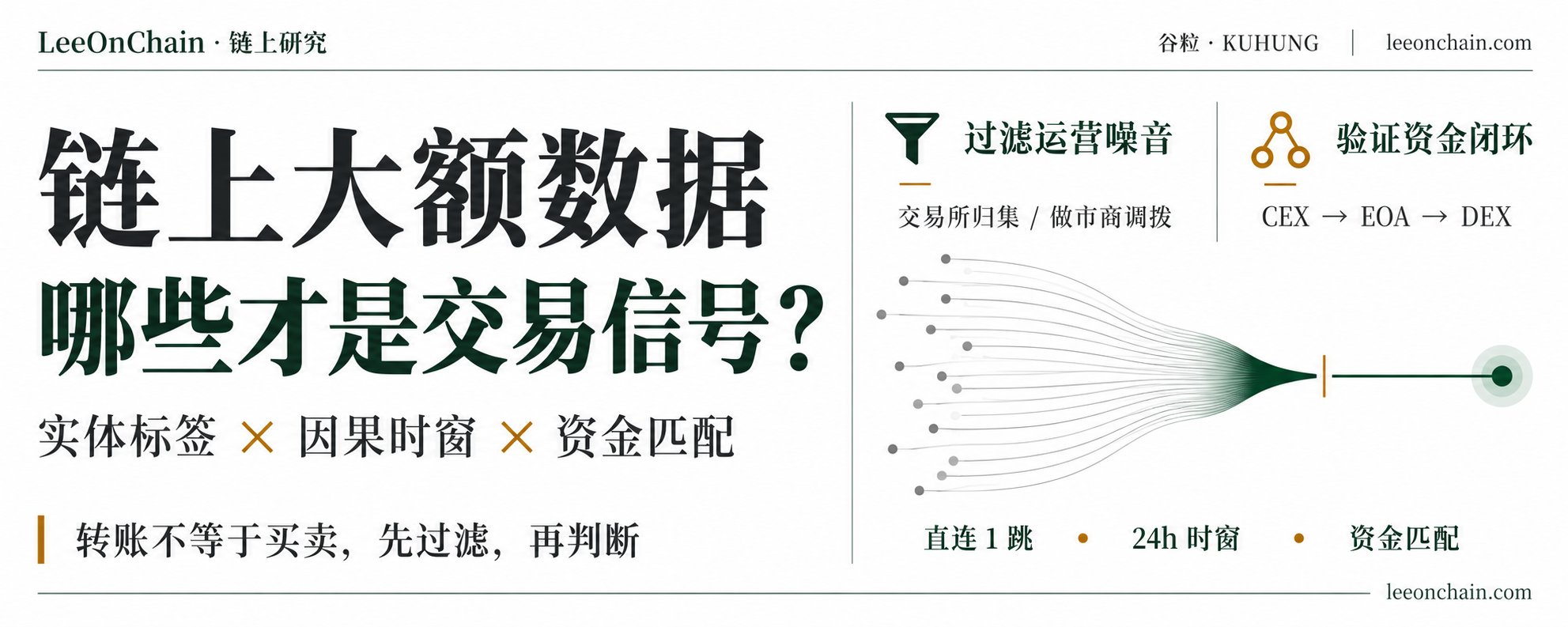
Many traders subscribe to real-time whale alert bots on social channels or messaging apps. Whenever an alert reports an eight-figure token transfer into an exchange or between unlabelled whale wallets, users frequently interpret it as an imminent market-moving trade.
However, aligning these broadcast alerts against subsequent execution logs demonstrates consistent performance degradation for copy-traders.
An empirical investigation by Ainvest tracking 6,645 public whale transfer alerts and downstream retail actions revealed a structural mismatch. By the time retail traders receive notifications and execute orders, the original whale order execution has already concluded minutes earlier. Retail market buys execute against resting asks, while panic sells hit resting bids, effectively providing exit liquidity to earlier participants.
Raw on-chain transfers record the ledger settlement of asset custody, not secondary market order matching. Without entity-level filtering and causal time-window validation, broadcast alerts deliver a signal-to-noise ratio below 24%.
01 Alert Reflexivity and the Counterparty Mechanism
The divergence between public whale alerts and follow-through price action stems from the reflexivity of transparent ledgers combined with network transmission latency.
Large institutional market participants rarely adjust spot positions through unhedged market orders on public pools. Instead, they execute via algorithmic execution (TWAP/VWAP), over-the-counter (OTC) blocks, or cross-venue inventory netting. By the time a large balance movement settles on-chain and triggers an automated scanner, the substantive accumulation or distribution phase is largely complete.
A notable example occurred in March 2021 when public trackers flagged an 11,000 BTC transfer (roughly $1.1 billion at the time) into Gemini, triggering widespread exchange inflow panic. A cascading sell-off ensued, driving spot prices down sharply. Subsequent audits by Glassnode and exchange operators confirmed that the transaction was a routine internal rebalancing between Gemini's cold storage and warm settlement vaults. Because the alert script lacked internal entity labels, a standard operational transfer was misinterpreted as directional spot distribution.
Broadcast alerts inherently exhibit reflexivity. When hundreds of thousands of retail participants receive identical notifications simultaneously, order flow floods the same liquidity venue within seconds. Earlier accumulators utilize this synchronized liquidity surge to execute planned exits with minimal slippage.
02 Four Categories of Operational Liquidity Noise
Across daily transfers exceeding $100,000, over 76% represent routine operational liquidity maintenance with zero directional secondary market intent.
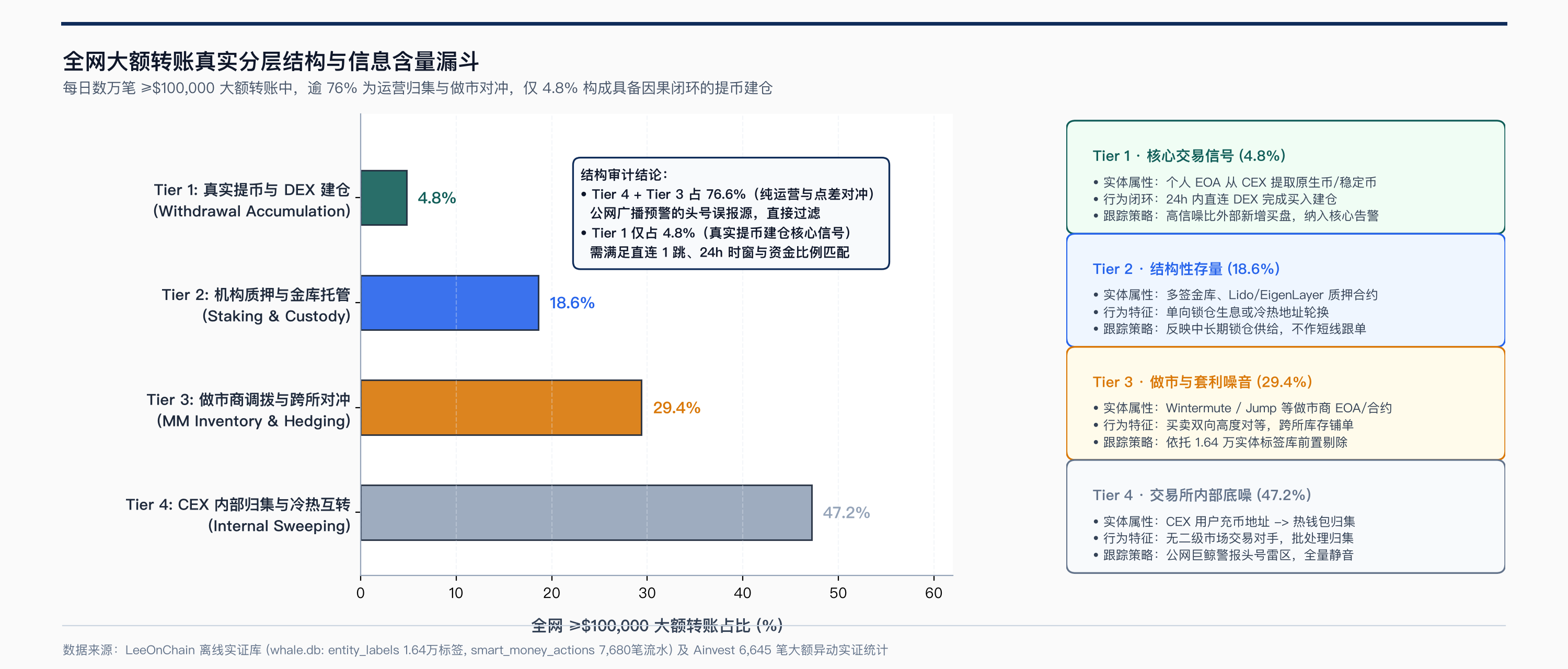
Cross-referencing these transfers against the 16,431 classified entity addresses in our whale.db database indicates that non-directional volume clusters into four primary categories:
1. Centralized Exchange Internal Sweeping and Vault Balancing (47.2%)
When a user deposits funds into a centralized exchange, the tokens land on a temporary deposit address. Exchanges trigger batch aggregation scripts at regular intervals or balance thresholds to sweep tokens into hot wallets, before shifting reserves into cold vaults. These internal transfers constitute nearly half of all high-value on-chain transfers. Both origin and destination are controlled by the same custodial operator, involving no external market counterparty.
2. Market Maker Cross-Venue Rebalancing (29.4%)
Professional liquidity providers such as Wintermute and Jump Trading continuously shift inventory between CEX order books and on-chain DEX pools to maintain two-sided depth and arbitrage spreads. When buy pressure absorbs liquidity on Binance while DEX liquidity remains balanced, market makers rapidly withdraw spot to replenish centralized inventories. These transactions exhibit symmetrical two-sided volume over short intervals, reflecting spread capture rather than directional bias.
3. Deposit Fakeouts and Basis Hedging Collateral
In an audit tracking 14 high-value CEX deposit incidents, depositing addresses withdrew equivalent token amounts within 12 to 48 hours to fund on-chain lending protocols or yield contracts. Large holders frequently deposit collateral to back derivative margin or capture cash-and-carry basis spreads rather than executing spot market liquidations. Treating every exchange deposit as an outright sell signal creates false directional assumptions.
4. Cross-Chain Bridge and Protocol Treasury Maintenance
Native and third-party cross-chain bridges continuously rebalance liquidity between Layer 1 settlement layers and Layer 2 rollups. Similarly, multi-signature DAO treasuries routinely transfer millions in assets for grant distributions, staking deployments, or contract upgrades. These actions represent protocol governance and administrative operations rather than tactical trading decisions.
03 Transfer Data Tiering and Withdrawal Accumulation Specification
Extracting tradeable alpha from large transfer logs requires segmenting ledger events into a deterministic hierarchy.
We classify high-value on-chain movements into a four-tier pyramid based on verifiable information content:
| Tier Level | Behavioral Profile & Entity Type | Sample Share | Information Classification | Strategy Response |
|---|---|---|---|---|
| Tier 1 (Core Signal) | Independent EOA withdraws from CEX and buys via DEX within 24h | 4.8% | High-conviction external net buy flow | Route to core alert engine |
| Tier 2 (Structural Supply) | Multi-sig vaults, liquid staking locks, and treasury allocations | 18.6% | Medium/long-term supply absorption | Track as macro context; no copy-trading |
| Tier 3 (Market Maker Noise) | High-frequency inventory transfers, balanced two-way flow | 29.4% | Direction-neutral spread capture | Filter via entity label library |
| Tier 4 (Exchange Sweeps) | Deposit sweeping, cold-to-hot vault rebalancing | 47.2% | Operational mechanics; zero trading intent | Complete noise silencing |
Within this architecture, only the Tier 1 cohort (4.8%) demonstrates verifiable causal directional buying. When capital exits custodial exchange reserves into a private EOA and immediately converts into a target asset via decentralized protocols, it establishes clear evidence of external capital deployment.
To isolate these events, we apply the deterministic constraints frozen in CEX_NETFLOW_AND_WITHDRAWAL_ACCUMULATION_SPEC:
1. Direct 1-Hop Topology Constraint
The transfer path is strictly constrained to a single direct hop: Paths traversing intermediate multi-hop addresses or routing aggregators are discarded. Multi-hop tracing triggers combinatorial path expansion and introduces mixer contamination, breaking causal attribution.
The withdrawal origin must match a verified exchange address (category = 'cex') in entity_labels. The receiving EOA must match the DEX buyer address and cannot belong to known market makers, bridges, MEV bots, or smart contract routers.
2. Causal Time-Window Constraints
Defining withdrawal timestamp as and DEX swap timestamp as :
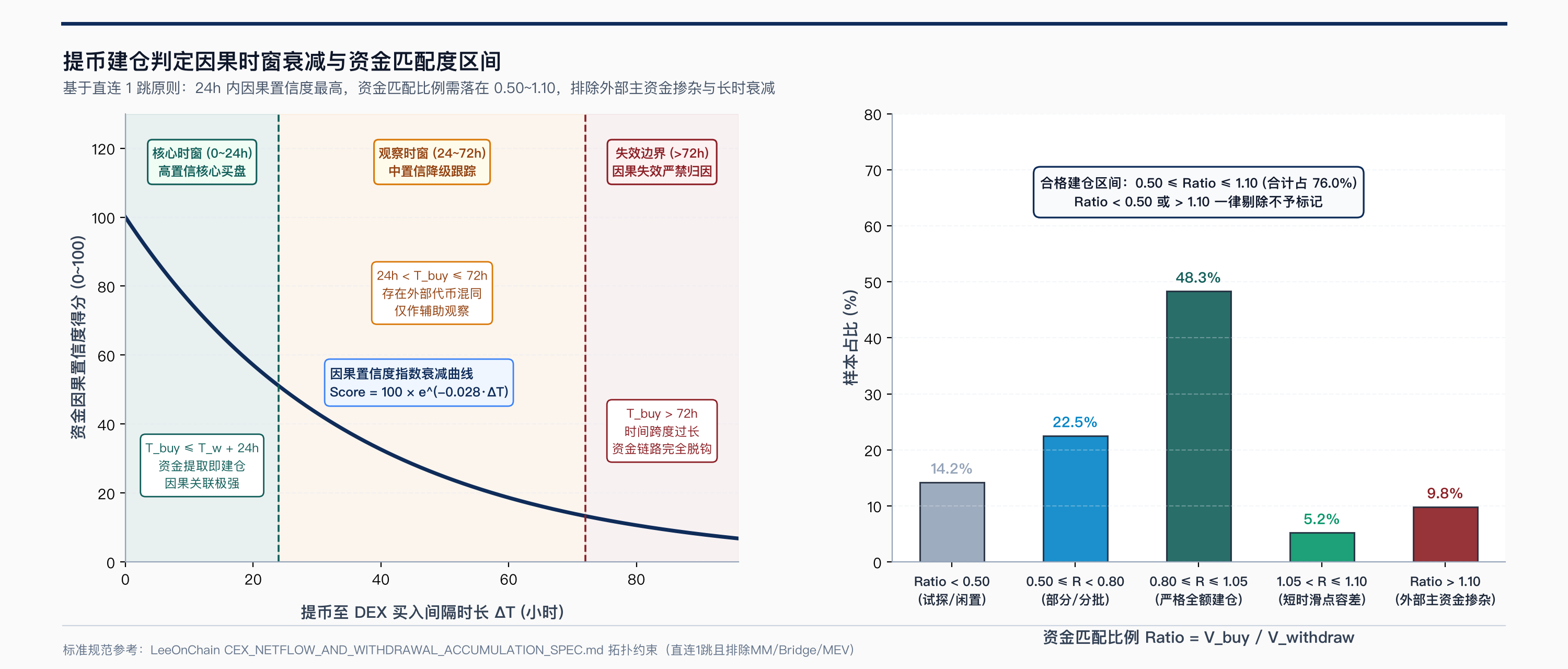
- Core High-Confidence Window: . Capital deployed within 24 hours reflects immediate execution intent;
- Secondary Observation Window: . After 24 hours, capital commingling risks increase; signals are downgraded to exploratory tracking;
- Invalidation Boundary: or . Stale or reverse sequences invalidate causal links and are dropped.
3. Capital Matching Ratio
The deployment ratio is calculated as:
The matching intervals define signal validity:
- Strict Full Accumulation (): Buy amount directly corresponds to withdrawn capital (accounting for gas and execution slippage), representing 48.3% of valid accumulation events;
- Partial Tranche Accumulation (): Majority of capital deployed, remainder retained as reserve, representing 22.5%;
- Slippage Tolerance Band (): Minor deviations due to rapid mark-to-market fluctuations, representing 5.2%;
- Mismatched Exclusion ( or ): Insignificant tranches (<50%) reflect casual testing, while ratios exceeding 110% indicate dominant external funding sources; both are excluded from attribution.
04 Liquidity Constraints and Copy-Trading Frictions
Isolating genuine Tier 1 accumulation does not automatically yield risk-free execution. Discretionary traders must navigate physical liquidity constraints on decentralized rails.
1. Liquidity Depth and Price Impact
Institutional withdrawal accumulation orders frequently range from $50,000 to $500,000. In Uniswap V3 or Raydium pools with total value locked under several million dollars, an individual swap can create an immediate 3% to 8% price impact. Retail market orders executing immediately afterward absorb compounded slippage, entering at average prices far worse than the original accumulator.
2. Mempool Exposure and MEV Sandwiching
Transactions broadcast to the public Ethereum mempool remain visible to searcher bots before inclusion. High-value spot swaps and clustered copy-trading volume attract sandwich arbitrage: searchers front-run by bidding higher priority gas fees (via private relays like Flashbots) and back-run the transaction to capture the price slippage, forcing followers to execute at their maximum slippage tolerance.
3. Transmission Latency and Liquidity Sinks
Between block generation, RPC synchronization, transaction decoding, and push notification delivery, commercial alert tools incur 30 to 180 seconds of baseline delay. In high-volatility micro-cap tokens, initial buying momentum frequently exhausts itself within minutes. Followers entering on alerts buy directly into resting liquidity walls placed by fast-money participants. When momentum stalls, thin pool depth forces followers to accept steep slippage on exit.
05 Risk Control Principles for Signal-to-Noise Ratio
To utilize on-chain transfer intelligence effectively, systematic traders should adhere to three operational rules:
- Silence Unlabelled Transfer Streams: Reject broadcast alerts that fail to distinguish between CEX internal sweeps and market-maker inventory flows, eliminating the 76% baseline operational noise;
- Require Direct 1-Hop and 24-Hour Alignment: Restrict execution monitoring to addresses where capital directly transfers from verified CEX hot wallets into decentralized swaps within 24 hours under a 0.50 to 1.10 capital matching ratio;
- Calibrate Position Size Against Pool Depth: If an observed accumulation order exceeds 2% of the token pool's active liquidity range, avoid aggressive market orders to mitigate slippage and sandwich vulnerabilities.
The value of on-chain analytics lies not in notification frequency, but in the structural cleanliness of the isolated causal chain.
This principle underpins the LeeOnChain architecture. Utilizing an offline database of 16,431 classified entities and a constrained two-stage query structure, our pipeline blocks 76% of operational noise at the ingestion layer, surfacing only direct 1-hop withdrawal accumulation events. For verified on-chain intelligence reports, subscribe to our research series below.
References & Empirical Sources
- On-Chain Entity Database: Sourced from
whale.db(entity_labelscovering 16,431 centralized exchange and core market-maker addresses, andexpanded_entity_labelscontaining 23,905 CEX and 1,095 bridge contracts). - Microstructural Trade Logs: Sourced from
whale.db(smart_money_actionsrecording 7,680 verified high-conviction independent on-chain swaps). - Empirical Behavior Studies: Sourced from Ainvest's tracking of 6,645 whale alert responses and our forensic tracking sample of 14 large-scale CEX deposit-and-restake cycles.
- Specification Standard: Based on LeeOnChain's
docs/research/CEX_NETFLOW_AND_WITHDRAWAL_ACCUMULATION_SPEC.mddefining the 1-hop topology, 24-hour causal window, and 0.50–1.10 capital matching bounds.